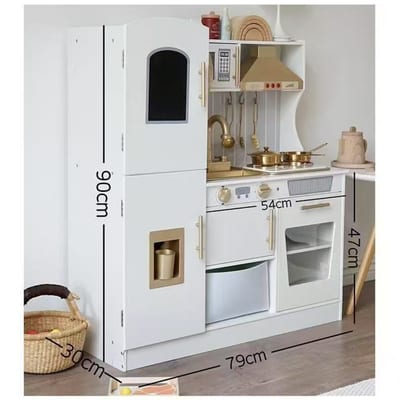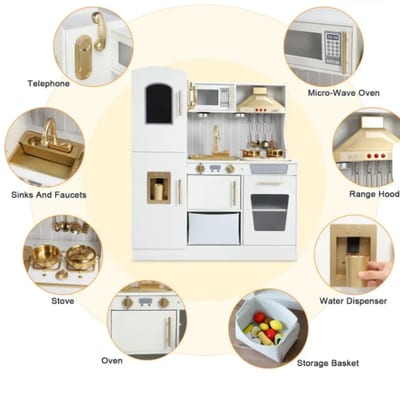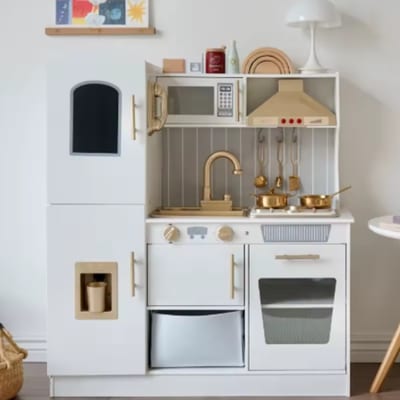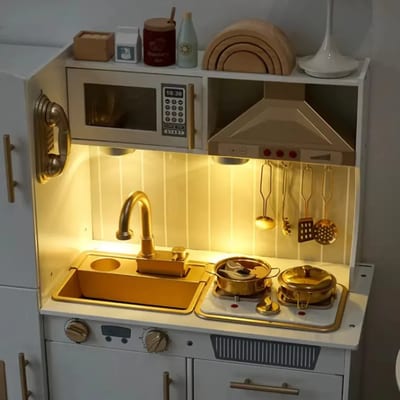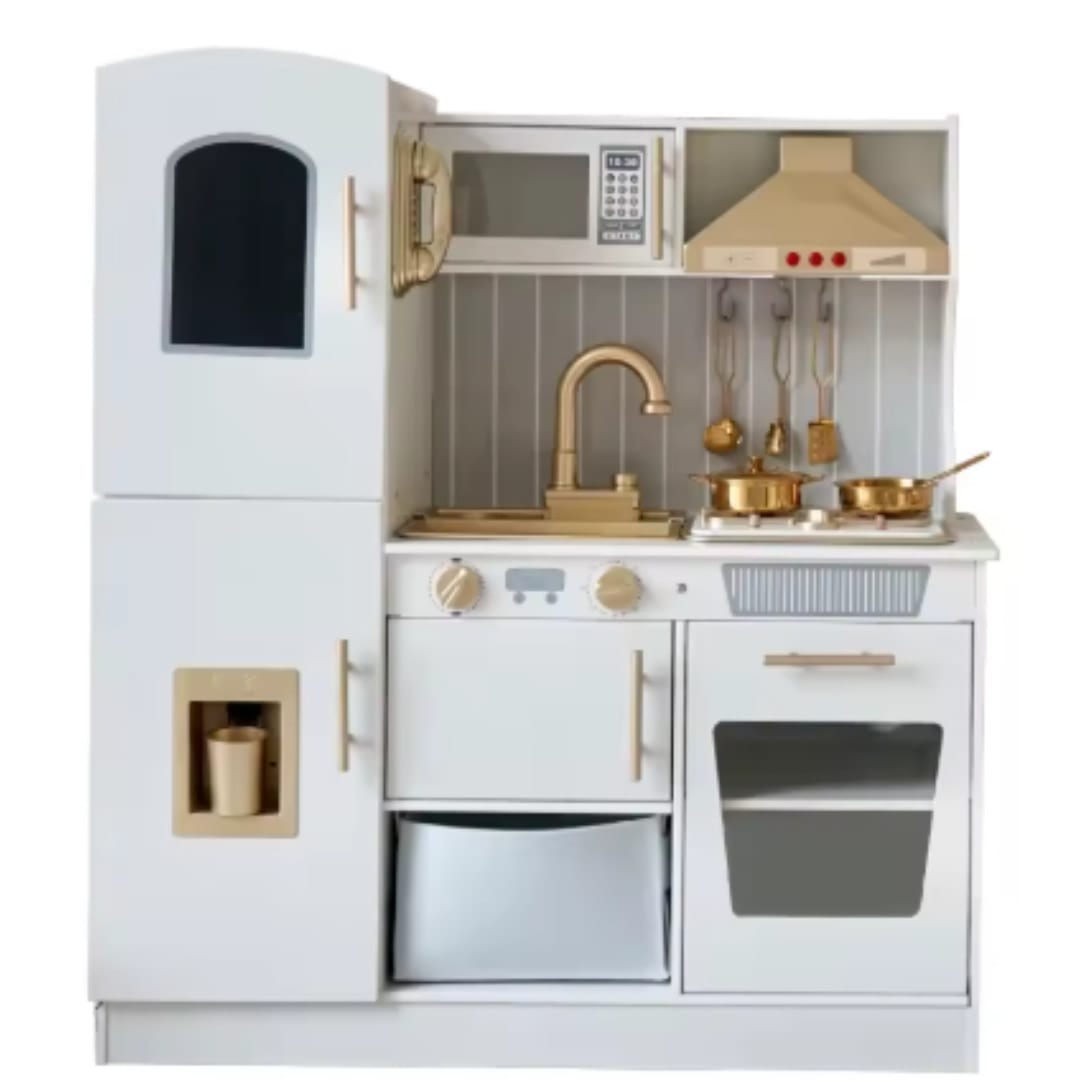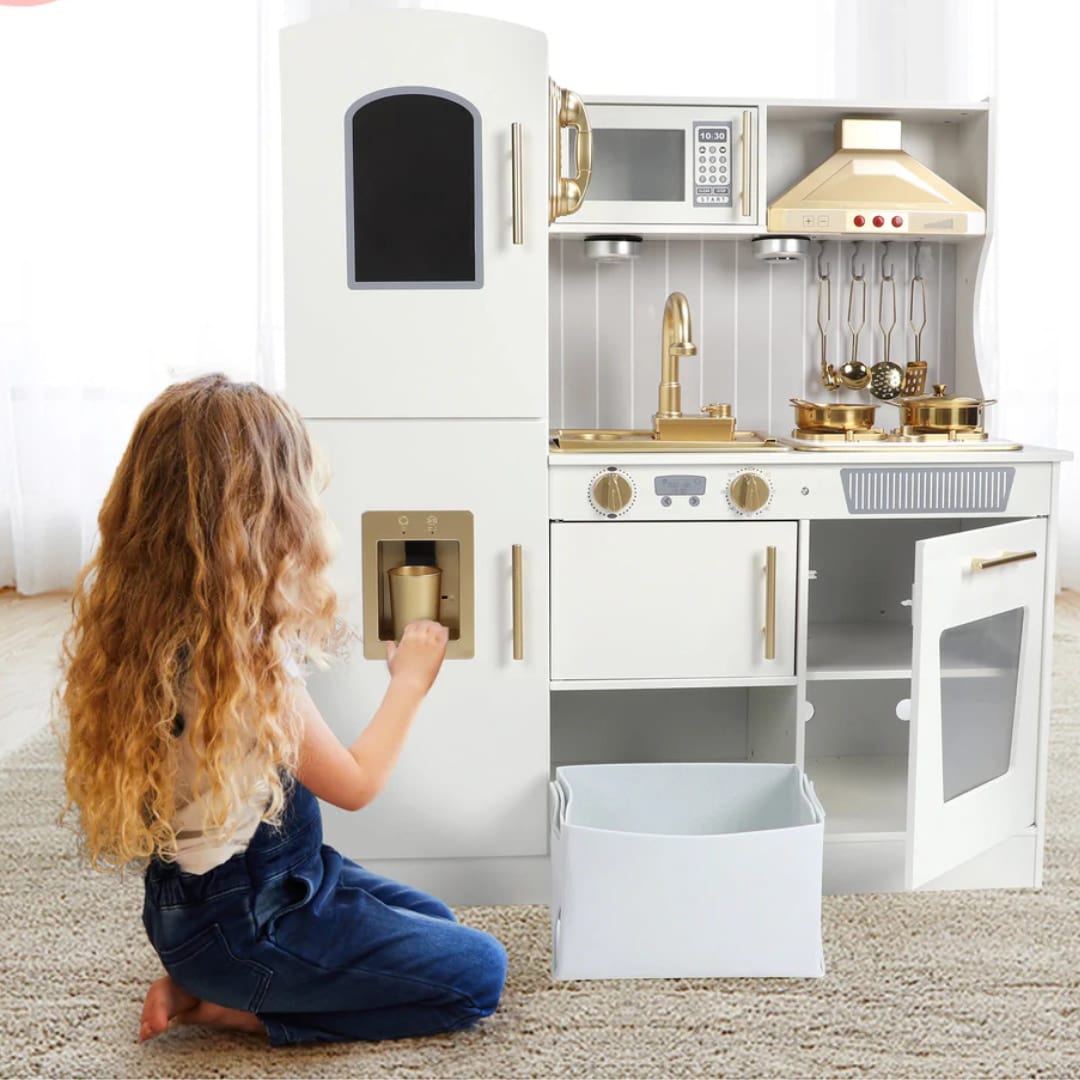
A grandmother likes to bring something small for her granddaughter's play kitchen every time she visits. This checklist is for her: what is already in the box, what to add first and what to add as the games grow.
Adding slowly is a good way to keep the kitchen fresh. Each new item gives the kitchen a fresh reason to be played with, and a small add-on makes a thoughtful gift for a birthday or a visit from granny.
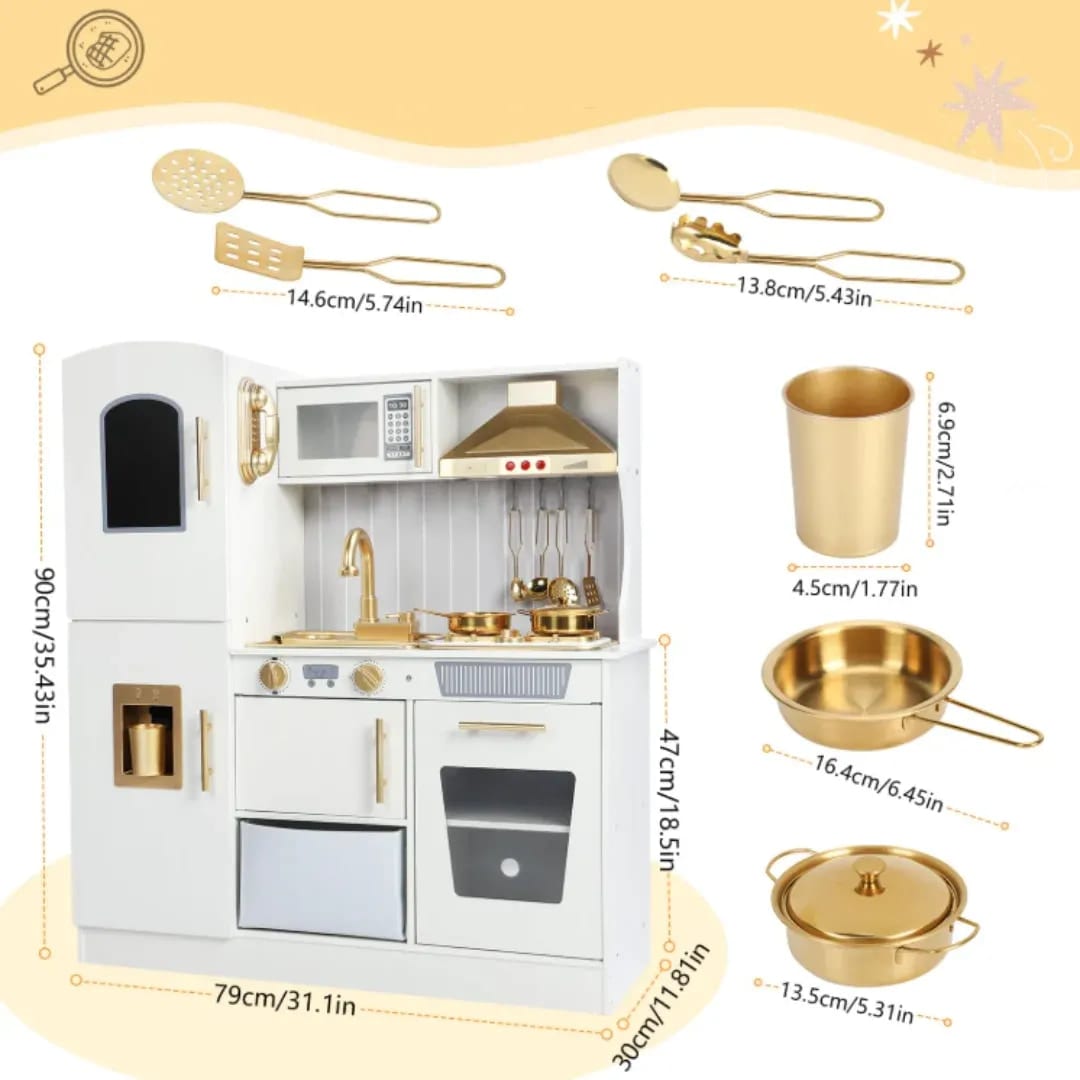
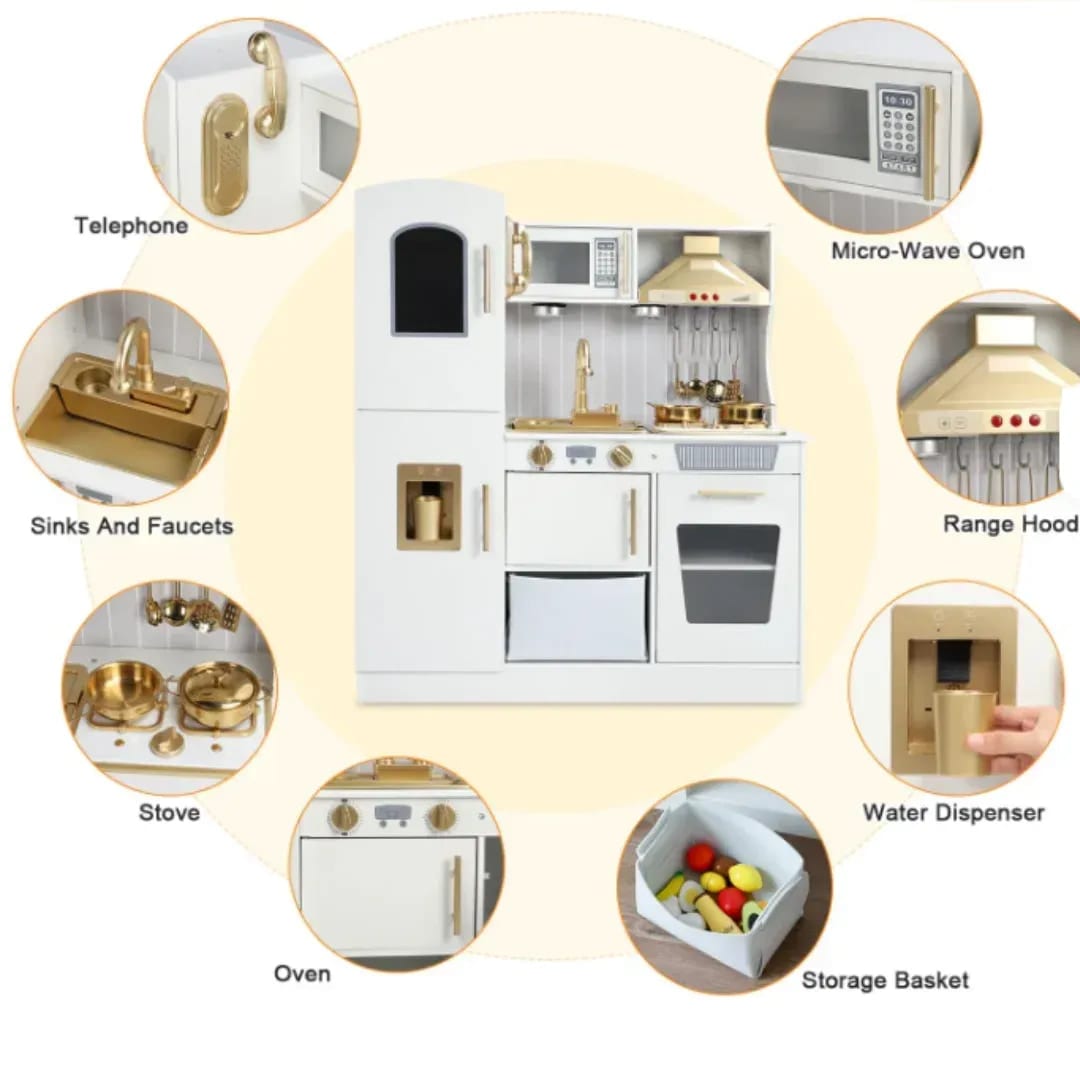
What comes in the box with our kitchen set?
- Gold pots with lids, for stews, rice and tea
- Gold pans, for chapati and eggs
- A spatula, for flipping
- A spoon, for stirring and serving
- Tongs, for serving
- Other cooking utensils, for every job in between
- Play food, for the very first meal
That list is enough to cook and serve straight away. Everything below is an extra that makes the games bigger. Add them slowly, one at a time, and watch which ones your child reaches for most.
What should you add to a play kitchen first?
The first things to add to a play kitchen are serving pieces: a few plastic plates and cups, and a child-sized apron. Cooking comes in the box, and serving is the other part of every meal. With plates on the table, the cook has guests, and the game moves from the stove to the dining room.
An apron is a small addition that gives the game a start and an end. Putting it on signals that the kitchen is open, and taking it off signals that the shift is over and tidy-up time has begun.
Which add-ons suit each age from 3 to 8?
The add-ons that suit each age follow the games children play at that age: simple serving pieces at 3, props for stories at 4, things for friends at 5, and paper and play money from 6. The table gives one or two ideas for each stage, all of them cheap or free.
| Age | What to add | What it brings to the game |
|---|---|---|
| 3 | Plastic plates and cups | Serving the meal to a teddy or a grown-up |
| 4 | An apron, a doll's table | A role to play and guests to cook for |
| 5 | A second apron, a small basket | A friend in the kitchen and shopping trips |
| 6 | Paper menus, a notebook | Writing orders and planning meals |
| 7 | Play money, price tags | Buying, selling and adding up |
| 8 | A toy till, recipe cards | Running a shop or a café |
For the full picture of how play changes with age, see our guide to what age a play kitchen is for.
What can you add from your own kitchen for free?
- Clean, empty food tins with smooth edges and the labels left on
- Empty cereal boxes and tea packets, taped shut
- Clean egg cartons for sorting and counting
- An old tea towel for drying up
- A wooden spoon and a plastic bowl
- A small basket from the market for shopping
Real packaging makes a pretend shop feel real and familiar. Check every item for sharp edges first, and leave glass and real knives in the real kitchen.
How do you add to a play kitchen without cluttering it?
Adding to a play kitchen without cluttering it comes down to one new thing at a time, a home for every piece and a box for the extras not in use. Give each addition a week or two before the next. That way the counter stays clear for cooking and every piece gets noticed.
For a full storage and rotation plan, see our guide to organising toys in a small house.
How do you store plates, aprons and menus?
Plates, aprons and menus are stored best in one small box or basket of their own, kept beside the kitchen. The pots and pans live in the kitchen's cupboards and the play food in its storage basket, so a separate box for plates, aprons and menus stops the cupboards overflowing. Tidying stays quick.
A lidded box under a bed or on a low shelf works well. Label it with a drawing of a plate, so even a 3-year-old knows where things go back.
Which play kitchen extras make good small gifts?
Play kitchen extras make good small gifts for relatives who want to add something on a birthday or a visit: a child-sized apron, a chef's hat, a set of plastic plates, a toy till or a book about food. Each one fits into the existing game, so the gift is used straight away rather than put on a shelf.
A gift like this also keeps the kitchen growing with the child. Over the years, the kitchen collects a little story of who gave what, and when.
Frequently asked questions
Does a play kitchen need play food? A play kitchen works best with some play food, because it gives the child something to cook, serve and put away. Our set comes with play food in the box, and homemade play food can be added later.
What plates and cups work best for a play kitchen? Light, unbreakable plates and cups work best for a play kitchen, such as plastic or melamine ones sized for small hands. Two or three of each is enough for a first table.
Should I add a toy till to a play kitchen? Adding a toy till to a play kitchen suits children from about 8, when shop and café games use money and sums. Before that, a small box for play money does the same job.
Is an apron worth adding to a play kitchen? An apron is worth adding to a play kitchen, and a child-sized one with a pocket gives the cook somewhere to keep a pretend order pad.
How much play food is enough? Enough play food for a play kitchen is enough to make two or three simple meals. Add more slowly, as new games need it.
What is a good gift for a child who already has a play kitchen? A good gift for a child who already has a play kitchen is an extra that grows the game, such as an apron, a set of plates, a toy till or a cookbook with pictures.
Can homemade play food replace bought play food? Homemade play food can replace or add to bought play food, and it can show the dishes your family eats. Our guide to DIY play food shows how to make chapati, ugali, mandazi and sukuma from felt and card.
How often should I add new things to a play kitchen? Adding one new thing to a play kitchen every month or two keeps it fresh without clutter. Birthdays, holidays and visits from relatives are natural moments for a new piece.
Which extras suit a kitchen shared by two children? Extras that suit a kitchen shared by two children are a second apron, a second spoon and a small table for the guests. With two of the most-used things, each cook has a job, and nobody waits for a turn.
Should play kitchen extras match the white and gold? Play kitchen extras can be any colour you like beside our white and gold set. Bright plates, a cloth from home and a homemade menu all sit well next to it, and your child can choose the colours.